
You spray in the morning, and by lunch you cannot smell it at all. Your friend wears the same bottle and is still getting compliments at dinner. So how long does perfume actually last on skin? The honest answer is a range, not a number, and once you know what moves that range, the mystery mostly disappears.
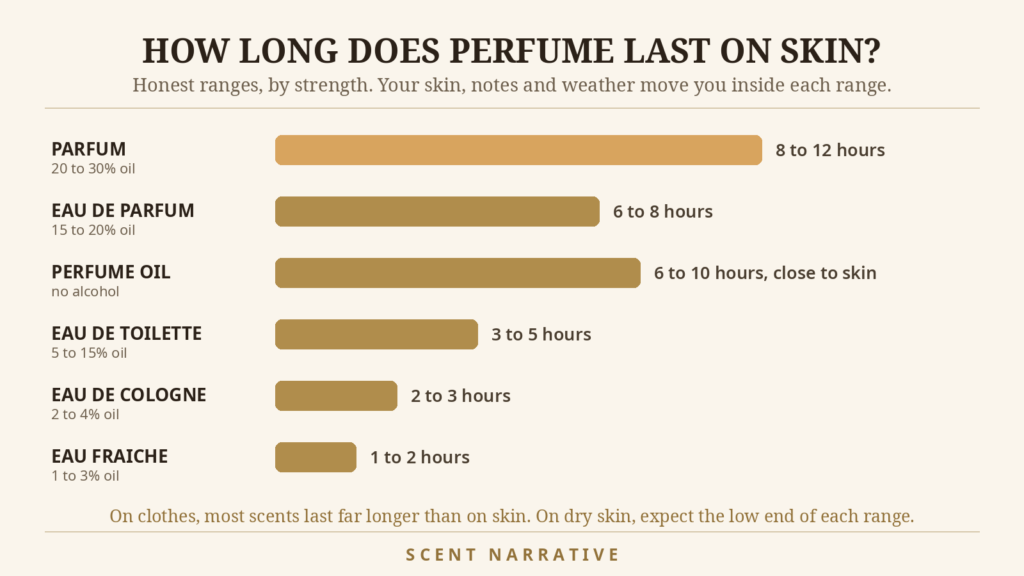
For most people, an eau de parfum lasts about 6 to 8 hours on skin. A parfum lasts longer, a toilette lasts less, and a fresh citrus scent of any strength will usually be gone before a warm vanilla scent of the same strength. Below is the full picture, strength by strength, and then the six reasons your hours may sit at the top or the bottom of each range.
The short answer, by strength
Parfum, also called extrait: about 8 to 12 hours. The richest strength, with 20 to 30 percent fragrance oil. It wears deep and close, and the base notes can still be there the next morning on the skin of your wrist.
Eau de parfum: about 6 to 8 hours. The strength most modern perfumes are sold in, at 15 to 20 percent oil. This is the all day standard, and the one our longevity ranges elsewhere on this site are judged against. If you want the full breakdown of strengths, our guide to perfume concentration explained covers what those percentages mean inside the bottle.
Perfume oil: about 6 to 10 hours, close to the skin. Oils carry no alcohol, so they do not lift into the air the way a spray does. They last quietly. Someone has to be near you to notice, and that is often the point.
Eau de toilette: about 3 to 5 hours. Lighter at 5 to 15 percent oil, with the fresh opening pushed forward. Expect a bright morning that softens by early afternoon, and plan a top up if the evening matters.
Eau de cologne: about 2 to 3 hours. At 2 to 4 percent oil, a cologne is a fresh splash, not a lasting statement. It was never built to last all day.
Eau fraiche: about 1 to 2 hours. The lightest form of all, close to a body mist. A gentle refresh, and then it is gone.
A single wear, in three acts
Longevity is not one scent fading evenly. A perfume wears in stages, and each stage has its own clock. The top notes, usually citrus, light fruit and fresh herbs, are the first impression and the first to leave, often within 15 to 30 minutes. The heart notes, the florals, spices and fruits that give a perfume its character, carry the middle of the wear for roughly 2 to 4 hours. The base notes, woods, vanilla, musk, amber and oud, are the lasting memory. They can hold on skin for 6 to 12 hours and on fabric for days. Our explainer on perfume notes walks through those three acts in more detail.
This is why two wearers can disagree about the same bottle. One person judges a perfume by its sparkling opening and calls it weak when the citrus leaves. Another judges it at hour seven, when the warm base is still there, and calls it a beast. Both are describing the same wear, at different acts.
Why the same bottle lasts longer on someone else
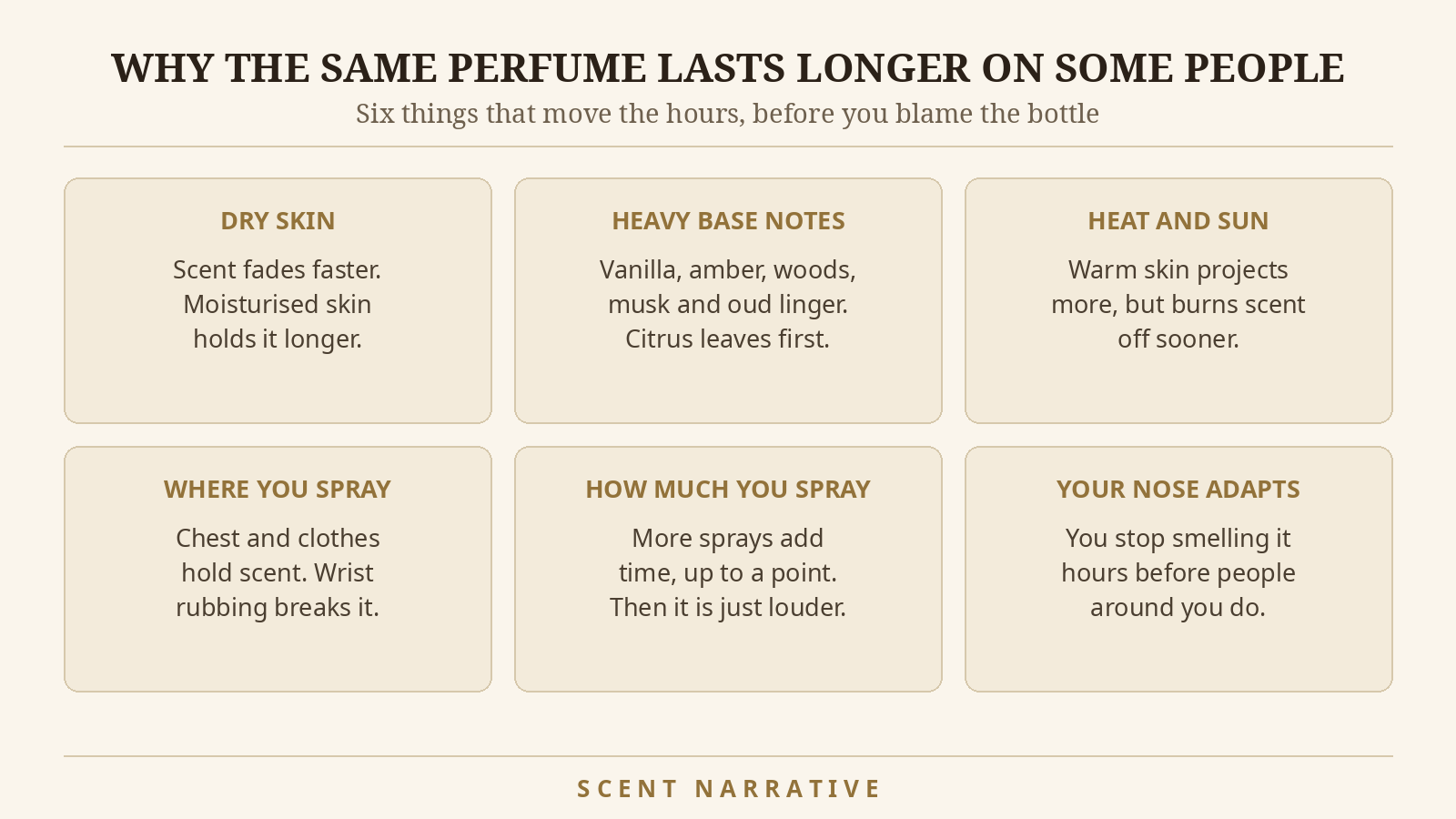
Your skin type. Dry skin gives fragrance very little to hold on to, so scent fades faster, sometimes hours faster. Skin that is moisturised, or naturally a little oily, holds the oil in a perfume and releases it slowly. If every perfume seems short lived on you, unscented moisturiser under your sprays is the simplest fix there is, and our next guides in this series will cover the full routine.
The notes themselves. Small, bright molecules evaporate quickly and heavy ones linger. That is the whole science of it. Citrus, green notes and light fruits sit at the short end. Vanilla, amber, woods, musk, resins and oud sit at the long end. A fresh summer scent is not failing when it fades by lunch. It is built from ingredients that were always going to leave early.
Heat, sun and weather. Warm skin makes perfume project more, and also burns it off sooner, so a scent can seem stronger and shorter lived on the same day. Cold air does the opposite: it slows evaporation and mutes the trail, so a winter wear often lasts longer while smelling quieter. Humid air tends to hold scent around you. Dry, windy air carries it away.
Where you spray. Warm, covered skin holds scent best, which is why the chest and the sides of the neck outlast an exposed wrist. Rubbing your wrists together after spraying does not help. It crushes the delicate top notes and shortens the part of the wear most people judge a perfume by. Spray, and let it settle.
How much you spray. Extra sprays do add time, up to a point. Two sprays may give you five good hours and four sprays may give you seven, but ten sprays will not give you a full day. Past a certain point you are only making the first hour louder.
Skin is not clothes
Most perfumes last far longer on fabric than on skin, sometimes into the next day and beyond, because cloth does not produce heat and oils the way skin does, and it does not shed its surface. That is why a coat or a scarf can greet you with yesterday’s base notes. It is also why a perfume can seem to vanish on your wrist while still being clearly present on your shirt. If you test longevity, test it on skin, because that is the honest measure, and keep one spray on fabric only if you are happy to live with that scent again tomorrow.
The problem is often your nose, not the bottle
Your nose adapts to a constant smell and stops reporting it. This is normal, and it happens with your own perfume within a few hours. The scent is usually still there. The people around you can smell it, which is why compliments so often arrive at the exact moment you have decided your perfume has died. Before you respray, ask someone near you, or smell the fabric of your sleeve away from your skin. Respraying into nose blindness is how a polite scent becomes the one that fills the lift.
How to test longevity honestly
Spray once on clean, moisturised skin in the morning, and write down the time. Check the same spot at two hours, four hours and eight hours, and note which act you are smelling, not just whether something is there. Ask one other person, once, in the afternoon. Then judge the bottle on the full day, not on the first twenty minutes at a shop counter and not on a paper strip, which can hold a scent far longer than your skin ever will. One full wear tells you more than five counter tests.
So, how long should yours last?
If you wear an eau de parfum with warm or woody notes on moisturised skin, expect a full working day, with the base still close at the end of it. If you wear a fresh toilette on dry skin in summer heat, expect a bright few hours and carry the bottle if the evening counts. Neither result means a perfume is good or bad. Longevity is a match between a formula, a skin and a day, and now you know which parts of that match you can actually change.